I was in a class about teaching writing today, and this came out as an answer to a prompt made of four words: sand, gold, blind, sea.
These words reminded me of Whitman’s poem “Starting from Paumanok,” where the lyrical voice speaks of an idyllic landscape, a not so idyllic family life, and the longing he-bird who cries for something greater than himself, perhaps the femme democracy, as its voice echoes into the infinite landscape and into the boy’s heart.
First published as in the 1860 edition of Leaves of Grass, with its contents divided between “Proto-Leaf” and “Reminiscence”,1 “Starting from Paumanok” is a song to the speaker’s dream-like childhood scenario, and the shadows that haunt it, as well as a play on “on the two themes of “Love” and “Democracy”” (Ivan Marki).
As my research focuses on Whitman and race, the prompt also reminded me of Lucifer, one of the most striking characters of the 1855 edition of Leaves of Grass. Voicing the pain and impotence of the enslaved man whose life is objectified, whose autonomy is violated, and whose family ties are perverted and defiled, Lucifer represents the very humanity of enslaved Blacks, so often overlooked, so often denied, and sidelined in favor of the economic gain of their traffickers and owners.2
This is how I imagine Lucifer might write back to Whitman, not as a demon, but as a very human, sentient, and agent man confronting his poetic creator and, in so doing, taking on the system that dehumanizes him.
***
To you I write, gray bearded good old friend, Whose feet walked naked on the sandy shores of Paumanok, and then, listening to the love song of the birds by the golden sea, grew blind to the toils of people like me.
Black devil, you said, plotting death, you claimed, whose blood is as read as mine, you sang, with a heart, and a soul, and a mind of his own.
Why did you create me this, ancient father, cruel tyrant, why did you breathe life into me, and brains, and courage, and a will to overturn your world?
You erased me, as if I never was. Tore me out of the pages where I lived. Stroke me through with your dagger-like pen. Why, oh why, did you allow me to dream sublime dreams of freedom, only to fetter me, and silence my cry, and drag me into dark oblivion?
For further information about “Starting from Paumanok,” please see the entry “Starting from Paumanok” (1860), by Ivan Marki, at The Walt Whitman Archive here. The 1860 edition of Leaves of Grass, is available online at The Walt Whitman Archive here.↩︎
For further information about the Lucifer passage, its composition and erasure, please see Ed Folsom’s entry “THE SLEEPERS” AND RACE” in his wider work WALT WHITMAN’S “THE SLEEPERS”, available online here.↩︎
Mientras toca el tema del acoso a las mujeres en la industria del entretenimiento, la serie establece paralelos entre el pasado medieval donde las mujeres, transgresoras del orden social de la época, eran apodadas de brujas y removidas del paisaje social a través de la tortura, persecución, y asesinato publico en la hoguera.
Mientras buscan compartir el peso de los roles que la sociedad les consigna en cuanto madres, hijas, cuidadoras, domésticas, las mujeres buscan asimismo crear comunidad. En “La Liberación,” las mujeres medievales la encuentran en el aquelarre de las brujas, el cual, sin embargo, las mantiene en el ámbito patriarcal, ya que pasan del dominio de lo que la serie llama “Sexy Jesus” al de Satan, él también una figura masculina. Escapando del dominio del patriarca socialmente aceptado, terminan cayendo bajo el dominio del anti-patriarca, si se toma la masculinidad opresora como metáfora del protector que eligen en un momento histórico marcado por creencias polarizadoras. Para la patriarquía, ella también polarizada y polarizante, las mujeres son o dóciles o brujas. En “La Liberación,” coincidentemente, la figura de la bruja se convierte en sinónimo de la mujer auto-determinada, que busca su camino personal lejos del dominio masculino. La caza a las brujas, por su parte, aparece como el mecanismo usado para estigmatizar y eliminar a las mujeres que no se amoldan al sistema patriarcal, tanto en el pasado como en el presente.
Además, los flashbacks históricos, superpuestos a las narrativas de las historias individuales de cada personaje, así como a la narrativa principal de la película (una adaptación de “Medea,” quien en la serie es presentada como la bruja por excelencia), que une a las cinco principales personajes contribuyen a la creación de paralelos entre experiencias femeninas del pasado y presente. En realidad, el sistema que oprime a las mujeres cambia de pelaje, pero, en esencia, permanece intacto. Tanto que, ayer como hoy, cuando las mujeres intentan rebelarse contra sus opresores y exponer su verdad, ellos se ensañan en su contra y tratan de silenciarlas.
Irónicamente, en “La Liberación,” la patriarquía es representada por un hombre ciego, retratada por el mismo actor que representa al “Sexy Jesus” y al director de “Medea”/ fundador de la secta del presente. (Es que también los personajes masculinos viven en paralelo). Poseedor de la llave del privilegio (una llave dorada que, supuestamente, todo lo abre), el patriarca hace y deshace, congrega a su alrededor a hombres que buscan mantener el status quo, y crea una secta (en el presente), análoga a la religión del pasado (de la cual el es representante principal y, a la vez, la figura divina), que usa métodos poco ortodoxos para seguir oprimiendo a las mujeres. Su objeto, como antaño, sigue siendo controlar los cuerpos y las mentes de las mujeres, mientras las relega a los márgenes de la sociedad, impidiéndolas de buscar soluciones para problemas que parecen no desaparecer pese a sus mejores y mas valientes intentos.
Definida como comedia negra, “La Liberación” se ve como una meditación sobre la historia de la opresión femenina a manos del sistema patriarcal, tanto de parte de los hombres, así como debido a la internalización de las reglas sociales patriarcales por ellos establecidas por las mujeres que, de esta forma, ayudan a perpetuar el sistema dominante.
En cuanto producción audiovisual, me ha encantado, por las representaciones visuales ofrecidas, la música, el vestuario y puesta en escena escogidos. Pero, más que nada, me gustó muchísimo la puesta en paralelo de vivencias presentes y realidades históricas, las cuales hicieron que las conexiones entre prácticas pasadas y presentes se hicieran más claras, poniendo así de manifiesto la omnipresencia de prácticas que cambian de forma, pero no de contenido.
The year was 1895, when merely three years had passed since Whitman’s demise. Horace Traubel, Whitman’s close friend and literary executor (as well as self-appointed keeper of his legacy), wrote a letter to one of the BoltonWhitmanites (the UK-based fans of Walt Whitman), J.W. Wallace.
In said letter to Wallace, dated June 13th, Traubel mentioned another letter, which he had received from Dr. Richard Maurice Bucke, where he is told of a pamphlet published by Edward Carpenter in 1894, under the title Homogenic Love and Its Place in a Free Society.
In Homogenic Love, while aiming to prove that homosexual individuals were as normal as everyone else (this is, after all, the late nineteenth century, and laws on homosexuality as a well as moral views of it are extremely prejudiced – the trial of Oscar Wilde, in the UK, is a paramount example of it) Carpenter wrote, on page 27, that,
“Walt Whitman, who certainly had the homogeny instinct highly developed, was characterised by his doctor, W. B. Drinkard, as having “‘the most natural habits, bases, and organisation he had ever met with or ever seen’ in any man. ‘In re Walt Whitman,‘ p. 115.”
Traubel, who has seemingly not read Carpenter’s pamphlet, manifests his displeasure at the insinuations that it contains about Whitman’s sexuality (see the letter below).
Letter from Horace Traubel to J.W. Wallace, 13 June, 1895. From the collections of Bolton Archives and Local Studies / Bolton Library and Museum Service.
I tried my hand at transcribing the letter, which is something that I left incomplete because I find Traubel’s handwriting to be quite difficult. The gist of it, however, is the reiterative dismissal of renewed suspicions regarding Whitman’s sexuality. Please let me know what you think, feel free to use it, complete it… And remember: you saw it here first 😉
Nevertheless, suspicions about Whitman’s non-conformity to the heteronormative practices that characterized the ideals of masculinity not only of the nineteenth century, but also of the American W(hite) A(nglo) S(axon) P(rotestant) culture and of the (inherited) Christian traditional morality, began already during his lifetime. A relevant example of these suspicions is available in a letter from John Addington Symonds, a preeminent British “biographer, literary critic, and poet in Victorian England, was in his time most famous as the author of the seven-volume history The Renaissance in Italy. But in the smaller circles of the emerging upper-class English homosexual community, he was also well known as a writer of homoerotic poetry and a pioneer in the study of homosexuality, or sexual inversion as it was then known.”1
Writing to Whitman from Davos on August 3rd, 1893, while searching for a confirmed shared ideology, Symonds speaks to the homoerotic content of the “Calamus cluster” of Leaves of Grass, saying, among other things, that
I agree with the objectors I have mentioned that, human nature being what it is, & some men having a strong natural bias toward
persons of their own sex, the enthusiasm of “Calamus” is calculated to encourage ardent & physical intimacies.
But I do not agree with them in thinking that such a result would be absolutely prejudicial to social interests, which I am certain that you are right in expecting a new Chivalry (if I may so speak) from one of the main & hitherto imperfectly developed factors of the human emotional nature. This, I take it, is the spiritual outcome of your doctrine in Calamus.2But I do not agree with them in thinking that such a result would be absolutely prejudicial to social interests, which I am certain that you are right in expecting a new Chivalry (if I may so speak) from one of the main & hitherto imperfectly developed factors of the human emotional nature. This, I take it, is the spiritual outcome of your doctrine in Calamus.
Whitman’s reply,3 dated August 19 of the same year, refuted said interpretation of his poems, stating:
that the calamus part has even allow’d the possibility of such construction as mention’s id terrible–I am fain to hope that the pages themselves are not to be even mention’d for such gratuitous and quite at the time undream’d & unreck’d possibility of morbid inferences–wh’are disavow’d by me & seem damnable.
Further, in an attempt to confirm his adhesion to heteronormative practices and dispel all doubts about the matter, Whitman adds the famous paragraph,
Tho’ always unmarried I have had six children–two are dead–One living southern grandchild, fine boy, who writes to me occasionally. Circumstances connected with their benefit and fortune have separated me from intimate relationships.
A this stage, I believe it is relevant to transcribe the note attached to this letter, by the editor of Whitman’s correspondence:
The original of this famous letter is apparently not extant, and for the first time the entire letter, which may have been rearranged and altered slightly in the final version is reproduced.
On August 3, using Havelock Ellis’. references tot he comradeship in The New Spirit as an introduction to a matter which gravely (and personally) concerned him, Symonds proceeded to ask a series of questions such as no one had put to the poet before: “In your conception of Comradeship, do you contemplate the possible intrusion of those semi-sexual emotions & actions which no doubt do occur between men? I do not ask whether you approve of them, or regard them as a necessary part of relation? But I should much like to know whether you are prepared to leave them to the inclinations & the conscience of the individuals concerned? . . . I agree with the objections I have mentioned that, human nature being what it is, & some men having a strong natural bias toward persons of their own sex, the enthusiasm of ‘Calamus’ is calculated to encourage ardent & physical intimacies. But I do not agree with them in thinking that such a result would absolutely be prejudicial to social interests” (Feinberg).4
If W W was upset by Symonds’ questions about the implications of “Calamus,” he was offhand at the beginning of his reply, perhaps deliberately so. That, however, he took the trouble to compose a draft letter–with an artfully deceptive sentence at the conclusion–indicates that this was no offhand answer.
Symonds’ reply on September 5 concealed his disappointment. As a disciple he thanked the poet for stating “so clearly & precisely what you feel about the question I raised.” But his opinion remained unchanged: “It seems to me, I confess, still doubtful whether (human nature being what it is) we can expect wholly to eliminate some sensual alloy from any emotions which are raised to a very high pitch of passionate intensity” (Feinberg). The same reservation appears in Studies in Sexual Inversion (1897):5 “No one who knows anything about Walt Whitman will for a moment doubt his candour and sincerity. Therefore, the man who wrote ‘Calamus,’ and preached the gospel of comradeship, entertains feelings at least as hostile to sexual inversion as any law-abiding humdrum Anglo-Saxon could desire. It is obvious that he has not even taken the phenomena of abnormal instinct into account. Else he must have foreseen that, human nature being what it is, we cannot expect to eliminate all sexual alloy from emotions raised to a high pitch of passionate intensity, and that permanent elements within the midst of our society will emperil the absolute purity of the ideal he attempts to establish” (1964 ed., 186). [See footnote number 5]
Embroiled in controversy from the very start, Whitman’s official sexual orientation, put out as a disclaimer of sorts, was far from being settled among his biographers and admirers (and continues to be problematic to this day). Despite not assuming his homosexual orientation publicly, Whitman’s poetry as well as his definition of democracy appear to have been unwilling or, at least, unconscious, testaments to his truth.
Unclarity notwithstanding, it is worth noting that a public confession of what, for the time, was considered transgressive sexual behavior, would have most certainly converted Whitman into a social outcast. Legally, however, matters were more nuanced, as, according to William N. Eskridge, “even if Whitman had engaged in anal intercourse (for which there is no evidence), it is most unlikely that he would have been arrested for violating the state [of New York’s] sodomy law, for its operational purpose was to regulate sexual assaults. […] This suggests that sodomy laws filled a regulatory gap as regards what we would today consider nonconsensual sex.”6
Source: Walt Whitman. The Correspondence, vol. V: 1890-1892. Edited by Edwin Haviland Miller, pp. 72-73. ↩︎
[Italics in the original; this is the transcript of a draft, which was acquired by Charles E. Feinberg, an avid collector. The Charles E. Feinberg Collection is presently housed at the Library of Congress; please see here for further information)]. See also the note to letter 2278 (the number assigned to this letter by the editor of The Correspondence, on “Appendix A: A List of Manuscript Sources and Printed Appearances,” where, among other things, it reads that “2278. Draft letter in Feinberg” (p. 323). ↩︎
The quote that follows does not appear in Studies in Sexual Inversion (although the correspondence cited here is addressed in this volume as well), but rather on p. 116 of Symonds’ 1896 book A Problem in Modern Ethics, where Whitman’s work is presented as one where same-sex love is openly invoked. It is not, however, impossible that the editor used a volume containing both works; hence I refrain from calling this a misquote. Considering the magnitude of the work at hand, nevertheless, it is not beyond the realm of possibility that Haviland Miller might have mistakenly cited something. ↩︎
The book that I am reviewing here was originally written in Spanish and is yet to be translated into English. Personally, I find it easier to write the review in Spanish, first, and then translate it into English. Thank you for your patience with me at this time!
*I also apologize for the drifting away, at times, but I felt like it helped to carry the point across.
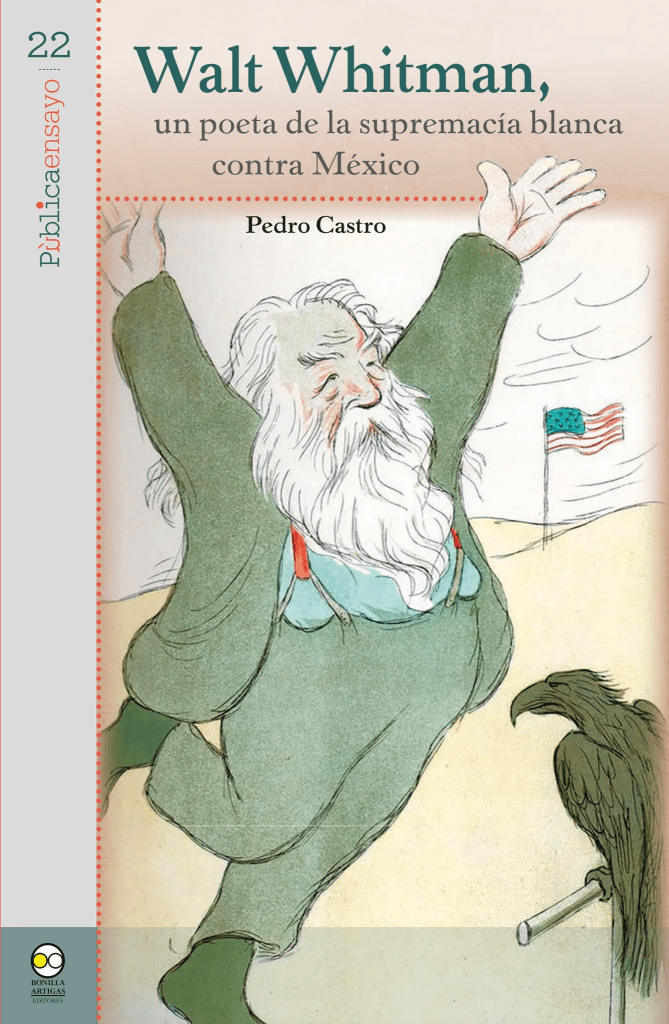
Walt Whitman: Un Poeta de la Supremacía Blanca Contra México,1 cuyo autor es el Dr. Pedro Castro Martínez,2 doctor en Historia y profesor catedrático en la Universidad Autónoma Metropolitana, fue publicado por la editorial Bonilla Artigas Editores en la Ciudad de México, corría el año de 2022. Cabe la nota de que Bonilla se presenta como “una editorial académica que publica y distribuye trabajos de investigación realizados en instituciones de educación superior, a fin de dar a conocer el conocimiento generado en México y otros países de habla hispana.”3
Enfocado en los años de la invasión de México por Estados Unidos que culminó en la guerra del 1846 al 1848 [“la primera guerra sostenida por Estados Unidos fuera de sus fronteras” (Castro 14)], la cual terminó con la capitulación de México y la cesión territorial formalizada por el Tratado de Guadalupe Hidalgo, el libro aquí reseñado revisita específicamente la narrativa oficial de Estados Unidos tal y cómo fue contada por Walt Whitman, así como la historia del México de entonces, contrastando las dos narrativas y su difusión dentro y fuera de las fronteras de ambas naciones. Para ello, Castro utiliza fuentes históricas de ambos lados, así como las obras de Whitman. Es de señalar que, a la época de estos acontecimientos, Whitman trabajaba como editor del The Brooklyn Daily Eagle.4 Su fundador, Isaac Van Anden, viendo cómo “el partido Demócrata no tenía ningún (órgano) que le defendiera de ataques o que advocara sus principios,” fundó el periódico para que éste fuera, “inicialmente [un vocero] del pensamiento y opinión Demócratas.”5 Sin embargo, con el tiempo, The Brooklyn Daily Eagle terminó convirtiéndose en “una parte integral de la propia ciudad, una expresión de las necesidades y los deseos del pueblo de Brooklyn.”6
Fue, sin lugar a dudas, un Whitman con claras aspiraciones políticas7 quien ocupó el lugar de editor en el Daily Eagle, lo cuál se puede comprobar, sobre todo, en la selección de editoriales sobre temas como el polémico Free Soil, la Guerra de México y la incorporación del estado de Oregon a la Unión, con la consecuente expansión de Estados Unidos hacia el Oeste y la leyenda del Destino Manifiesto (Castro 24, 30, 122). Eran esos, sin duda, tiempos únicos, debido a la cantidad de cambios que estaban sucediendo simultáneamente, así como a las atrocidades que, en nombre del progreso y de la (alegada) expansión civilizacional se estaban perpetrando.8
Es, entonces, desde esta perspectiva de Americano y Demócrata, que Whitman emprende su andadura periodística en el Daily Eagle entre “marzo de 1846 y enero de 1848, desde donde elogió las glorias conquistadoras de Estados Unidos” (Castro 24). Y son estas ideas (las cuales Castro desentraña en su obra) las que, igualmente, van influir en su poesía y en su prosa, dentro y fuera de los periódicos, en éste momento especifico, y en el futuro.
Recurriendo el índice de Walt Whitman,9 se puede tener una visión general del libro, así cómo intuir el trabajo de contextualización llevado a cabo. Entender la historia de Estados Unidos es, por ende, relevante para comprender al hombre que afirmó que la característica que manifiesta la estatura de un poeta es el “que su patria lo incorpore tan entrañablemente cuánto éste la ha incorporado a ella.”10 Esa incorporación, sin embargo, abarcó, en la persona de Whitman [y digo persona como el simulacro criado para el público así como el hombre por detrás de esa proyección; categorías esas que, hasta el día de hoy, se confunden la uno con la otra debido a “la desaforada autopromoción” que lo animó a lo largo de su carrera (Castro 23)], los aspectos tanto positivos cómo negativos de una nación y sus ciudadanos, de los cuales el hombre Walt Whitman quiso presentarse como representante, entre ellos la “ideología imperialista” que nutrió el ambiente cultural dónde Whitman y su obra se desarrollaron. En ese sentido, según Castro, Whitman
fue uno de los propagandistas de la expansión de Estados Unidos, de su Destino Manifiesto, de la pureza biológica de los blancos, de la supuesta ‘renovación’ de la democracia en los territorios arrebatados de Nuevo México y Alta California, y de la independencia y anexión de Tejas. (11, itálico en el original)
Castro, por ende, no rehuye de tocar el tema del racismo y xenofobia contenidos en los escritos de Whitman, los cuales reflejan una ideología que estaba, a la fecha, ampliamente difundida entre sus coetáneos, y para la cuál Whitman hubiese sido “un voluntario eslabón” (11), haciendo alusión a
sus [de Whitman] expresiones negativas hacia México y los mexicanos, los afroamericanos y los habitantes originarios del suelo americano, así como [a] la exaltación de los anglosajones como los únicos portaestandartes de la democracia, la libertad, y el progreso. (11)
Y es que, habiendo bebido de los avances dichos científicos de su tiempo, entre los cuales están las teorías de la jerarquía racial defendidas por pseudociencias como la Frenología y la Craniología (o Craneometría),11 las cuales Whitman conoció por intermedio de sus amigos, los hermanos Fowler. Whitman, en su día, hizo su lectura frenológica en la tienda de sus amigos, e imprimió la segunda edición de sus Hojas de Hierba en su taller en 1856.12
Además, Castro también toca el tema de la creación de una narrativa de conquista por parte de los Estados Unidos para justificar lo que fue una invasión. A través del uso de expresiones como “Mexican War, que señala a México como el responsable de la guerra,” o “California was ceded from Mexico en 1848 [sic], cuando la realidad fue que Estados Unidos conquistó y puso de rodillas a México,” el autor pone de manifiesto la versión de los vencedores (15).13 Y es que, entonces, la vilificación del adversario estaba a la orden del día, y no solo se criticaba a los Mexicanos por ignorantes faltos de educación formal, además de “malos, sucios y de apariencia patibularia,” por no decir incapaces de autogobierno (Castro 225),14 sino que se equiparaba a la nación en sí a una mujer que necesitaba ser sometida por la fuerza. Hablando de la victoria en Matamoros, en un editorial titulado “Victory,” 2 del 19 de mayo del 1846, Whitman dice lo siguiente,
Much as we regret the sanguinary part of the business, we cannot see our way clear, as yet, to desist fro prosecuting the war with equal vigor, until Mexico is prepared to make peace, to respect our rights, and to keep herself to herself.
[…] We are sure the American soul is too magnanimous to crush an enemy who may be in its power. Will we not make terms with Mexico–fair but generous terms? Will we not endeavor to conquer her by forbearance, after we have conquered her by our cannon?
[…] Any body with brains in his head, cannot help seeing that the United States must conquer. Why, what a comparison! This republic–the richest nation on earth,–the fullest of means of men, of moral power–running over with the elements out of which such great victories are made–the nation of nations;–this to be pitted against such a state as Mexico–land of Zamboes and Mestizoes–distracted, impoverished, with no reality about it–where the very freedom they are quarreling for is not begun to be understood–where the officers and the priests are despotic and the people slavish!15
Todos estos calificativos siguen siendo usados modernamente, y son reciclados cuando la necesidad de sembrar la discordia y la división surge. Se culpa al inmigrante y se le otorgan calidades que, más que nada, lo categorizan como el otro y el culpable de los males sociales del cotidiano.16
En cuanto se refiere a dicha ideología, a la que Castro se refiere como “la mitología del hombre blanco,” (17), la cual el autor relaciona con la expansión de Estados Unidos hacia el Oeste, esta está representada por dos personajes clave que mueven la narrativa de conquista de un territorio que se decía virgen, puesto que los que lo habitaban no eran considerados seres humanos. La expansión, alimentada por la “mitología de hechos” que era el Destino Manifiesto era, entonces, encarnada por “las figuras heroicas” del “pioneer (pionero) y del cowboy (vaquero),” los cuales, según Castro, al fin, fueron creados con el fin de “adormecer el juicio crítico de los estadounidenses,” sirviendo de eslabón a “las siguientes invasiones de Estados Unidos a todos los países que son de su interés” (18). Y Whitman, en su afán de cantar al laborioso hombre Americano, también los cantó a ellos, con “loas paternales, y abundantes signos de admiración” en su poema “Pioneers! Oh Pioneers!,”17 el cual, cuando leído a la luz de la invasión y el genocidio, de la guerra, el prejuicio, la subyugación, y la propaganda, toma proporciones verdaderamente oscuras y perturbadoras, una vez que ensalza el sufrimiento continuado de hombres y mujeres que se quedaron sin bienes, fueron despojados de su dignidad e identidad, y reducidos a la nada.
Have the elder races halted?Do they droop and end their lesson, wearied over there beyond the seas?We take up the task eternal, and the burden and the lesson, Pioneers! O pioneers!
All the past we leave behind,We debouch upon a newer mightier world, varied world,Fresh and strong the world we seize, world of labor and the march, Pioneers! O pioneers!
Las ideas de raza, cómo se puede ver, son una constante, y en éste poema, se puede observar cómo, a través del trabajo esforzado, la nueva raza conquista, literalmente, el terreno a la antigua, que cae bajo el peso de su cansancio y, quizás de su incapacidad de sostener la tierra que habita. La misma idea, aparece en un pasaje citado por Castro, que aparece en la obra With Walt Whitman in Camden, donde Horace Traubel, íntimo amigo del poeta, transcribe las conversaciones e vivencias de los últimos años de Whitman, a propósito de lo que Whitman llamaba la amalgamación de las razas.
“el negro, como el injun (manera despectiva de referirse al habitante originario de América), sería aliminado: es la ley de las razas, la historia, es el what-not.” (traducción de Castro, 124)18
En Walt Whitman, a través de la comparación entre las distintas narrativas ofrecidas sobre la Guerra entre Estados Unidos y México por los vencedores y los vencidos, Castro expone Walt Whitman, el poeta-propagandista de América, cómo vocero de una potencia que, pese a definirse como democrática y progresista, en realidad no mira a medios para alcanzar sus objetivos. El que el propio Whitman se preste a ello pone de manifiesto la verdad por detrás de sus ideas aparentemente universales, así como el contraste entre su persona literaria y su realidad personal. Sin embargo, lejos de constituir una contradicción, esto demuestra hasta qué punto Whitman absorbió su país hasta identificarse con él tanto en ideología cómo en la práctica. Para los que quieran una perspectiva más matizada de la guerra en cuestión, así como una descripción del lado menos popular de Whitman, éste es un libro muy interesante, que recomiendo vivamente.
Referido en adelante, por razones de brevedad, cómo Walt Whitman. ↩︎
Para más informaciones sobre el Dr. Castro Martínez, su carrera académica y sus publicaciones, véase su sítio web aquí. ↩︎
Para una reseña de los orígenes y de la agenda claramente demócrata del periódico véase el artículo “The Brooklyn Daily Eagle is Born,” en la página 17 de Pictorial history of Brooklyn, issued by the Brooklyn Daily Eagle on its seventy-fifth anniversary, October 26, 1916, accesible online en Internet Archive: https://archive.org/details/pictorialhistory00weyr/page/17/mode/1up↩︎
Ver nota 3. En la página 17 de la obra citada previamente, se dice que el primer número del periódico fue publicado el 26 de octubre del 1841, haciendo de él un periódico relativamente reciente en la época a la que Whitman se incorporó a la plantilla. ↩︎
Para un sumario del envolvimiento de Whitman en la política de su tiempo, véase “Political Views,” un artículo de Bernard Hirschhorn en el Walt Whitman Archive, aquí. ↩︎
Eran éstos tiempos en los que, bajo el estandarte del progreso y de la civilización se cometían atrocidades del más variado tipo, que además están bien documentadas. Me refiero aquí a la aniquilación de los pueblos nativos bajo argumentos científicos y religiosos que defendían una superioridad racial y cultural, que conllevaba el derecho a territorios, personas y posesiones una vez los colonizadores se encontraran en territorios no cristianos. Para una descripción del origen de dichas ideas así como de su aplicación en el contexto Estadounidense, véase Native America, Discovered and Conquered: Thomas Jefferson, Lewis & Clark, and Manifest Destiny, por Robert J. Miller, con el Prefacio de Elizabeth Furse, accesible en Internet Archive aquí. ↩︎
Para una muestra del libro, donde se incluyen el ídice y algunos capítulos del mismo, véase la entrada en Google Books aquí. ↩︎
Véase el editorial escrito por Whitman para el Daily Eagle del 13 de febrero del 1847, intitulado “Peace with Mexico,” dónde Whitman habla como si la culpa de que la guerra continue sea de México, el cual tiene la obligación de rendirse: “We are as much in favor of peace with Mexico as any one can be–but how on earth are we to get peace, while our adversary obstinately persists in carrying on the war, and refusing to receive our diplomatic agents?” (The Collected Writings of Walt Whitman: The Journalism, vol. II, p.198). ↩︎
Véase también los siguientes editorials escritos para el Brooklyn Daily Eagle: ↩︎
Véase el ejemplo de Trump, que, en su día, calificó a los Mexicanos de “bad hombres,” o cuando dijo que los Mexicanos que entraban en Estados Unidos eran criminales y violadores. Para un sumario de las instancias en las que Trump fue menos correcto con los Mexicanos, véase el artículo del 10 de noviembre de 2016, “Taco Trucks to Bad Hombres: 7 Times Latinos Figured In Trump’s Campaign,” por Raul Reyes en NBC. ↩︎
Para más informaciones sobre la publicación e historia del poem, véase la entrada para “Pioneers! oh Pioneers!” en The Walt Whitman Archive. ↩︎
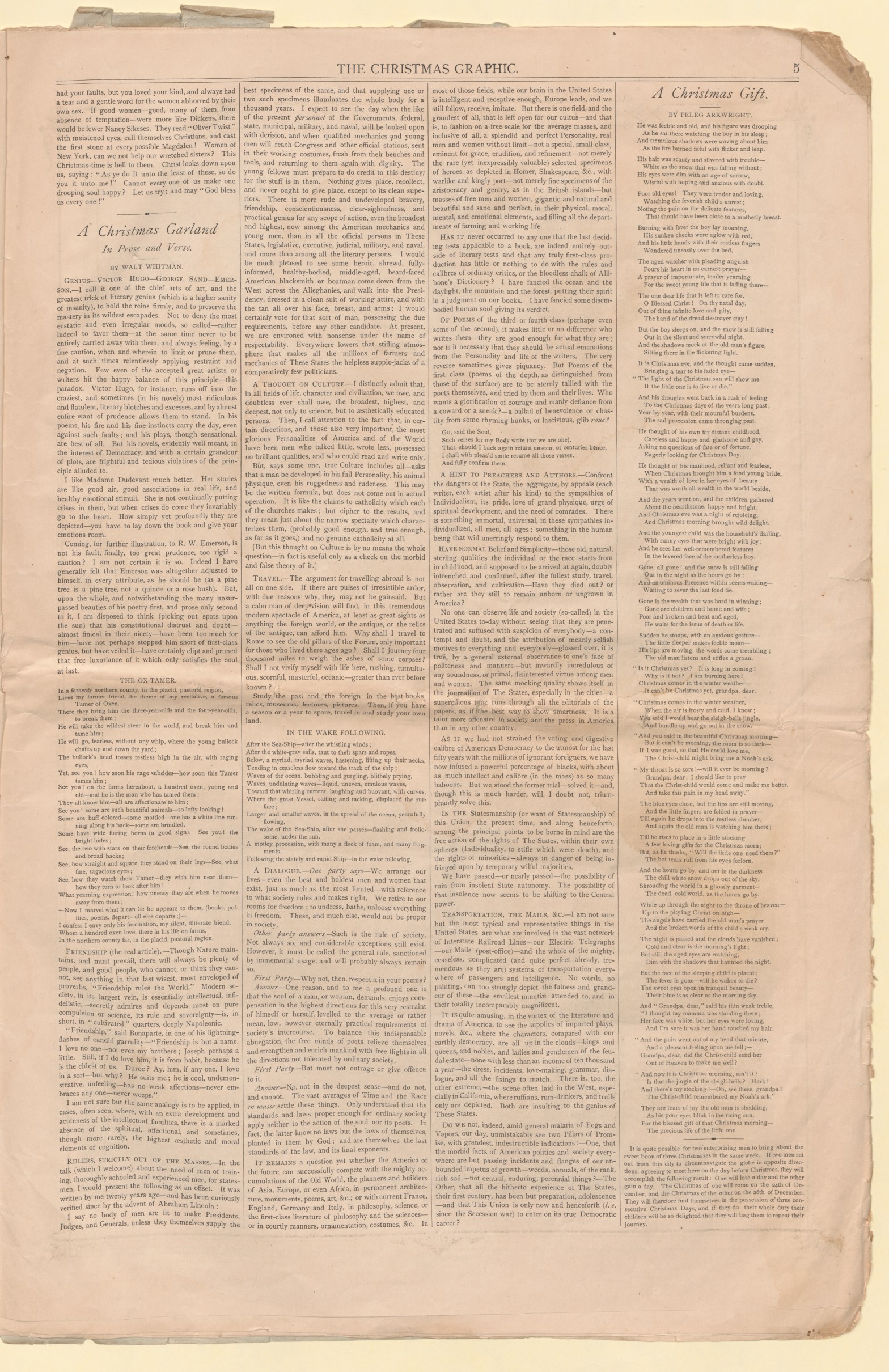
“A Christmas Garland in Prose and Verse,” by Walt Whitman from the Christmas Graphic: A Special Number of the New York Daily Graphic, from December 25th, 1874, p. 5. Image from the Joel Myerson Collection of Nineteenth-Century American Literature, Irvin Department of Rare Books and Special Collections, University of South Carolina Libraries.
As a part of my ongoing doctoral research, which focuses on the recent calling out of Walt Whitman’s problematic racist statements, I have seen that a common reference is often cited: Whitman called Black people baboons. This specific instance is documented in an article that Whitman wrote for the Christmas edition of the New York Daily Graphic in 1874,1 and that has been graciously scanned upon request by the wonderful librarians at the University of South Carolina, whom I wish to thank for all their help. The newspaper, which is available in its entirety at the archive, was acquired by Prof. Joel Myerson a scholar and avid collector of memorabilia pertaining to famous-nineteenth century American authors. A prolific writer, Myerson’s academic works include books and articles about Emerson, Dickinson, Whitman, Margaret Fuller, Hawthorne, Thoreau, and the Alcotts, as well as Transcendentalism in general (you can find references to his work on WordCat here, and I would also suggest checking his page on goodreads to have maybe a faster idea of what his booklist looks like.)
This text, which appears as a mish-mash of unrelated topics would be comparable, perhaps, to more recent practices, such as the sections of newspapers or magazines, or even the piece at the end of the news on t.v., when journalists review the year that has ended and make predictions or suggestions for the year to come.
This specific article, however, is suggestive because it is one of the few that is actually signed by Whitman, where his views on his country as well as of the place of freed Blacks in it is stated in an evident manner. Even though Whitman tries to give a more optimistic spin to it, when he states that American Democracy will “I doubt not, triumphantly solve this” hardest of trials.
This article was first transcribed, partially, by Emory Holloway, an early twentieth-century Whitman scholar, in the second volume of The Uncollected Poetry and Prose of Walt Whitman, available from the Internet Archive here. For volume I, see here.
As a part of my research, I have compared both versions side by side, specifying what Holloway chose to include and not to include, as well as cross-references to other places within both Whitman’s and Holloway’s works that are referenced throughout.
I am annexing the transcript below, which is, at present, still under construction.
If you choose to use it, please give me credit. And if not, thank you for at least reading through my post and my work: you are very much appreciated!

 The (In) Famous Academic