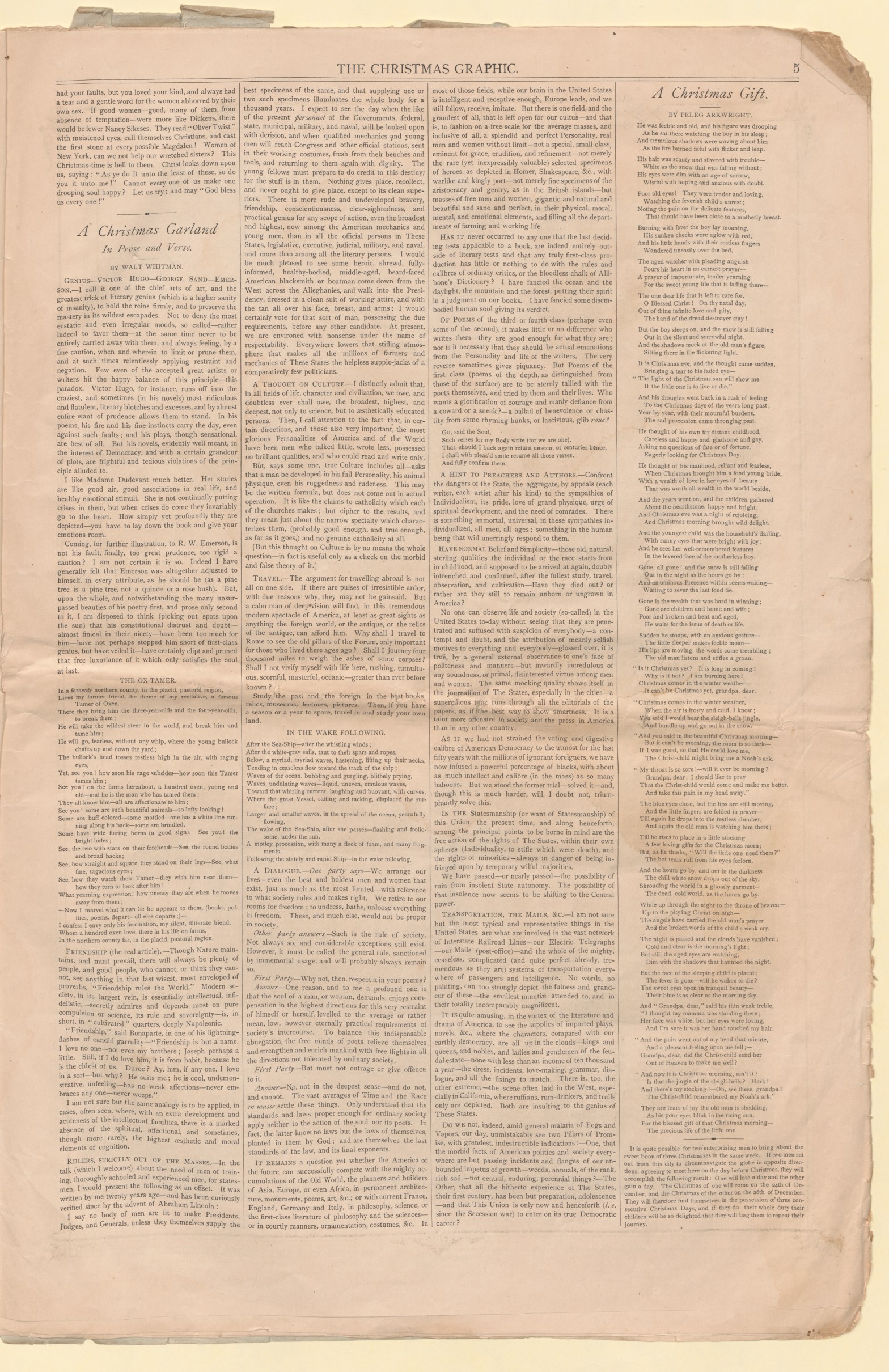
“A Christmas Garland in Prose and Verse,” by Walt Whitman
from the Christmas Graphic: A Special Number of the New York Daily Graphic, from December 25th, 1874, p. 5.
Image from the Joel Myerson Collection of Nineteenth-Century American Literature, Irvin Department of Rare Books and Special Collections, University of South Carolina Libraries.
As a part of my ongoing doctoral research, which focuses on the recent calling out of Walt Whitman’s problematic racist statements, I have seen that a common reference is often cited: Whitman called Black people baboons. This specific instance is documented in an article that Whitman wrote for the Christmas edition of the New York Daily Graphic in 1874,1 and that has been graciously scanned upon request by the wonderful librarians at the University of South Carolina, whom I wish to thank for all their help. The newspaper, which is available in its entirety at the archive, was acquired by Prof. Joel Myerson a scholar and avid collector of memorabilia pertaining to famous-nineteenth century American authors. A prolific writer, Myerson’s academic works include books and articles about Emerson, Dickinson, Whitman, Margaret Fuller, Hawthorne, Thoreau, and the Alcotts, as well as Transcendentalism in general (you can find references to his work on WordCat here, and I would also suggest checking his page on goodreads to have maybe a faster idea of what his booklist looks like.)
This text, which appears as a mish-mash of unrelated topics would be comparable, perhaps, to more recent practices, such as the sections of newspapers or magazines, or even the piece at the end of the news on t.v., when journalists review the year that has ended and make predictions or suggestions for the year to come.
This specific article, however, is suggestive because it is one of the few that is actually signed by Whitman, where his views on his country as well as of the place of freed Blacks in it is stated in an evident manner. Even though Whitman tries to give a more optimistic spin to it, when he states that American Democracy will “I doubt not, triumphantly solve this” hardest of trials.
This article was first transcribed, partially, by Emory Holloway, an early twentieth-century Whitman scholar, in the second volume of The Uncollected Poetry and Prose of Walt Whitman, available from the Internet Archive here. For volume I, see here.
As a part of my research, I have compared both versions side by side, specifying what Holloway chose to include and not to include, as well as cross-references to other places within both Whitman’s and Holloway’s works that are referenced throughout.
I am annexing the transcript below, which is, at present, still under construction.
If you choose to use it, please give me credit. And if not, thank you for at least reading through my post and my work: you are very much appreciated!
And remember: You read it here first!

 The (In) Famous Academic